

Across the vast agricultural belts of Central Asia and Eastern Europe, regional farming enterprises and energy providers face a critical regulatory and logistical challenge: the disposal of millions of tons of post-harvest crop straw (wheat, corn) and heavy cotton stalks.
Open-field burning is strictly prohibited due to severe air-quality mandates and carbon penalties. Meanwhile, loose agricultural residue possesses an extremely low bulk density (60–90 kg/m³), making long-distance transport economically unviable.
Guoxin Machinery delivers an end-to-end Turnkey Crop & Cotton Straw Carbonization to Briquetting Line Solution. Our integrated system combines automated biomass shredding, continuous oxygen-free pyrolysis carbonization, high-pressure mechanical briquetting, and thermal drying. This engineering solution transforms bulky agricultural waste into high-density, high-calorific solid bio-coal briquettes tailored for industrial boilers and municipal district heating grids.
For regional farming conglomerates, state-backed agricultural cooperatives, and thermal energy developers, carbonizing and briquetting crop straw upgrades low-value residue into a premium, drop-in solid fuel that directly replaces sub-bituminous and lignite coal.
1.1 Material Property Transformation Data
| Evaluation Metric | Raw Crop & Cotton Straw | Carbonized Bio-Coal Briquettes |
| Moisture Content | 15% – 35% (Highly Variable) | < 5% (Hydrophobic & Stable) |
| Fixed Carbon (FC) | 14% – 18% | 55% – 65% |
| Net Calorific Value (LHV) | 3,200 – 3,600 kcal/kg | 4,800 – 5,400 kcal/kg |
| Ash Content | 5% – 8% | 12% – 18% (Stable non-clinkering ash) |
| Bulk Density | 60 – 90 kg/m³ | > 1,150 kg/m³ (High Volumetric Energy) |
| Storage & Transit | Prone to degradation/rot | Immune to biodegradation and self-ignition |
1.2 Core Commercial Advantages
Elimination of Environmental Liabilities: Provides a legal, localized processing route for high-volume harvest waste, eliminating open-field burning fines.
Drastic Transport Cost Reduction: Compacting and carbonizing compresses loose stalks to less than 10% of their original raw volume, enabling cost-effective long-distance rail and truck logistics.
Thermal Off-Grid Reliability: Finished bio-coal briquettes deliver an affordable, low-sulfur solid fuel source for regional decentralized heating infrastructures during extended sub-zero winters.
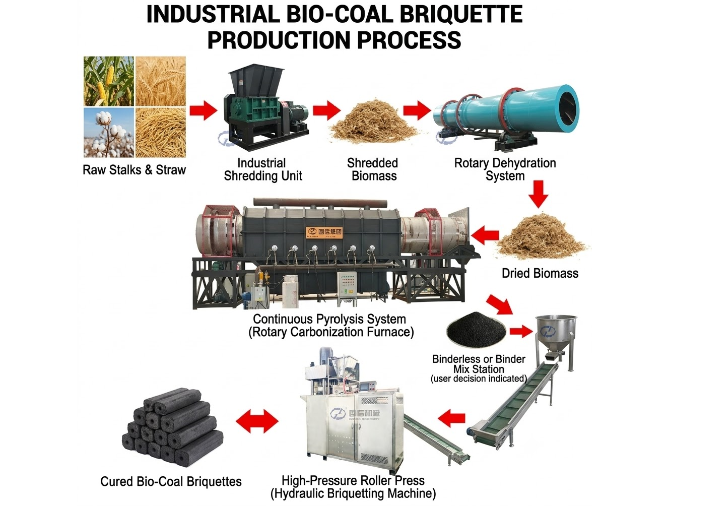
Cotton stalks and grain straw differ significantly from standard wood biomass due to their fibrous structure, light bulk density, and high volatile content. Our solution incorporates an automated, closed-loop 7-stage processing sequence calibrated specifically for agricultural residue dynamics.
[Raw Straw/Cotton Stalks] ➔ [Shredding & Anti-Bridging Feed] ➔ [Rotary Drying] ➔
[Continuous Pyrolysis Kiln/Continuous Rotary Drum Carbonization Furnace] ➔ [Anaerobic Water-Cooled Discharger] ➔ [Binder Mixing & Muller] ➔
[Hydraulic/Roller Briquette Press] ➔ [Mesh Belt Dryer] ➔ [Finished Bio-Coal Briquettes]
2.1 Mechanical Pre-Conditioning & Anti-Bridging Feeding
Raw baled or loose straw and tough cotton stalks are fed into heavy hammer mills and tub grinders to achieve a uniform particle length of 3mm to 8mm. To prevent lightweight, fibrous straw from interlocking and clogging downstream hoppers, feed silos are equipped with live-bottom screw dischargers and anti-bridging mechanical agitators.
2.2 Waste-Heat Driven Rotary Dehydration
Harvested crop residue exposed to weather can exceed 30% moisture content. The solution routes high-temperature flue exhaust from the carbonization kiln into a Multi-Pass Rotary Drum Dryer to bring internal moisture down to < 12%, stabilizing downstream thermal decomposition rates.
2.3 Continuous Oxygen-Free Pyrolysis Carbonization (400°C – 550°C)
Conditioned straw particles enter our Continuous Rotary Carbonization Kiln. Operating under strict negative pressure and a sealed, oxygen-free atmosphere, the straw undergoes rapid pyrolytic transformation. This concentrates fixed carbon while managing volatile compounds to prevent slagging or clinkering.
2.4 Sealed Anaerobic Water-Cooled Carbon Discharging
Hot biochar exiting the carbonization furnace reaches temperatures between 400°C and 500°C. To eliminate spontaneous combustion risks upon atmospheric contact, the material passes through an enclosed water-jacketed cooling screw conveyor. This brings the charcoal powder temperature down below 40°C safely in an oxygen-free environment.
2.5 Syngas Fractionation & Heat Recycling
Combustible gases (CO, CH₄, H₂) released during carbonization are pulled through cyclonic ash separators and tar scrubbers. Cleaned syngas is redirected back into the kiln burners. Once steady-state operating temperature is reached, the plant functions as a self-sufficient thermal loop, reducing external burner fuel costs by up to 75%.
2.6 Binder Homogenization & High-Pressure Briquetting
Cooled charcoal powder lacks natural lignin cohesion. It is transferred to a wheel muller mixer / Double-Shaft Mixer and blended with a 3%–5% eco-friendly starch binder paste and water. The prepared damp mixture is fed into a heavy-duty Hydraulic Charcoal Briquette Press or High-Pressure Double-Roller Press (operating at line pressures up to 80–120 kN/cm). Depending on client requirements, the line produces high-density pillow, oval, cubic, or hexagonal briquettes.
2.7 Multi-Pass Mesh Belt Dehydration
Freshly pressed “green” briquettes carry an internal moisture level of 15%–18%. They are conveyed through a continuous multi-pass mesh belt dryer, where regulated hot air reduces moisture content to < 5%. This step guarantees high Cold Crushing Strength (CCS > 1,200 N) and prevents briquette degradation during transport and bulk handling.
| System Component / Subsystem | Solution Engineering Capabilities |
| Line Feed Throughput | 2.0 TPH to 15.0 TPH (Tons Per Hour raw feed input) |
| Continuous Carbonization Kiln | Heat-resistant alloy drum (Q245R/Q345R boiler plate) with negative pressure loop |
| Biochar Cooling Discharger | Enclosed dual-layer water-jacketed screw conveyor (Discharge Temp < 40°C) |
| Briquette Molding Unit | High-tonnage hydraulic press (100–300 Ton force) or double-roller press |
| Molded Shapes & Density | Pillow, Oval, Cubic, or Hexagonal formats; Density > 1.1 g/cm³ |
| Briquette Drying System | Multi-layer continuous mesh belt dryer with zoned temperature regulation |
| Automation & PLC Controls | Centralized Siemens PLC touchscreen with remote SCADA telemetry and sensors |
| Emissions Control | Cyclone dust collectors, tar scrubbers, and pulse-jet baghouses (< 20 mg/m³) |
Guoxin Machinery provides comprehensive EPC (Engineering, Procurement, and Construction) services for global bio-coal project developers:
Extreme Cold-Weather Adaptation: All outdoor piping, hydraulic stations, and feeding mechanisms feature high-efficiency thermal insulation jackets and heat tracing to operate seamlessly down to -35°C in extreme northern winter conditions.
Custom Material Handling Systems: Storage silos and conveyors are customized for lightweight crop residue to eliminate material bridging, dust explosion risks, and feed line blockages.
Complete Turnkey Execution: Full delivery from initial civil foundation drawings and custom plant layout to equipment erection, electrical integration, and operator training certification.
Q1: How do straw bio-coal briquettes perform compared to traditional coal in industrial heating boilers?
A: Straw bio-coal briquettes deliver heat output comparable to mid-grade lignite coal (4,800 – 5,400 kcal/kg) while containing virtually zero sulfur (< 0.05%). They operate as a carbon-neutral fuel source, allowing municipal heat providers to bypass carbon taxes and utilize existing boiler grates without retrofitting.
Q2: How does the carbonization system prevent slagging caused by silica and potassium in cotton straw?
A: Slagging occurs when raw agricultural biomass is burned in open conditions at temperatures exceeding 800°C. Our continuous pyrolysis furnace operates within a strictly controlled thermal window of 400°C to 550°C, keeping volatile ash minerals stable and unmelted so the resulting bio-coal will not foul boiler tubes or cause grate clinkering.
Q3: Why is a mesh belt dryer necessary after the charcoal press stage?
A: Carbonized straw char powder requires a small amount of liquid starch binder (15%–18% moisture) to form strong bonds under pressure. The multi-pass mesh belt dryer systematically evaporates this moisture down to < 5%, ensuring finished briquettes achieve maximum crushing strength (CCS > 1,200 N) and will not crumble during handling or transit.
Q4: What safety mechanisms protect the carbonization and briquetting line during operation?
A: The system incorporates an automated negative-pressure loop. Hot charcoal is cooled inside an airtight, water-jacketed screw conveyor prior to air contact, eliminating self-ignition risks. Combustible syngas lines are continuously monitored by dual-redundant oxygen sensors, water-seal flame arrestors, and automated nitrogen purge valves.
Henan Guoxin Machinery operates a dedicated material testing center in Zhengzhou, China.
Project developers and agricultural cooperatives can send raw crop or cotton straw samples for lab-scale carbonization, briquetting, and density testing.
Our engineering team provides complete technical project documentation:
Mass & Yield Balance Reports: Volumetric mass ratios of raw straw relative to carbonized briquette output.
Calorific & Ash Analysis: Precise bomb calorimeter testing and ash fusion point analysis.
Custom Plant Footprint Layouts: 2D and 3D plant designs tailored for severe cold-climate operating conditions.
