

Municipal environmental authorities, industrial wastewater treatment facilities, and solid waste processing plants face escalating regulatory pressure regarding byproduct disposal. Traditional management strategies—including open-air landfilling, ocean dumping, and high-emission mass incineration—are increasingly restricted by strict environmental mandates, rising tipping fees, and stringent groundwater protection acts.
Guoxin Machinery engineers heavy-duty, continuous Industrial Sludge & Solid Waste Carbonization Plants. Utilizing advanced, indirect-fired rotary pyrolysis technology, our systems thermally decompose complex organic matrices in an oxygen-free environment.
This process achieves maximum volume reduction, eliminates hazardous organic compounds, immobilizes heavy metals, and transforms low-value waste into stable, eco-friendly carbon products or industrial fuel briquettes.
Our carbonization lines are engineered to handle a diverse matrix of complex solid wastes and high-moisture industrial bioproducts.
| Sourcing Sector | Waste Feedstock Type | Technical Challenge Solved | Final Carbon Output Application |
| Municipal WWTPs | Sewage Sludge / Dewatered Biosolids | Destroys pathogens, microplastics, and concentrated PFAS compounds. | Low-emission industrial fuel or structural concrete additive. |
| Hydraulic Engineering | River Dredging Sediments / Sludge | Drives off high organic binders; locks up heavy metal contaminants. | Inert construction aggregate or eco-bricks. |
| Textile & Paper Mills | Industrial Dyeing & Pulp Sludge | Eliminates highly toxic complex aromatics, synthetic polymers, and chemical binders. | Concentrated solid fuel or industrial adsorbent media. |
| Paper Industry Rejects | Plastic-Paper Composites / Reject Pulp | Processes highly variable moisture and irregular particle sizing cleanly. | High-calorific refuse-derived fuel (RDF) bio-coal. |
| Recycling Facilities | Sorted Municipal Solid Waste (MSW) | Eliminates biological fermentation, odor vectors, and leachate risks. | High-density solid fuel briquettes for industrial boilers. |
| Electronics Recycling | Non-Metallic E-Waste Matrices (Fiberglass/Resin fractions) | Extracts volatile organic resins safely while isolating stable inert fiberglass solids. | High-density industrial fillers or asphalt modifiers. |
To ensure reliable, 24/7 continuous operation with highly abrasive and variable waste streams, our lines integrate automated mechanical pre-conditioning with multi-zone thermal control loops.
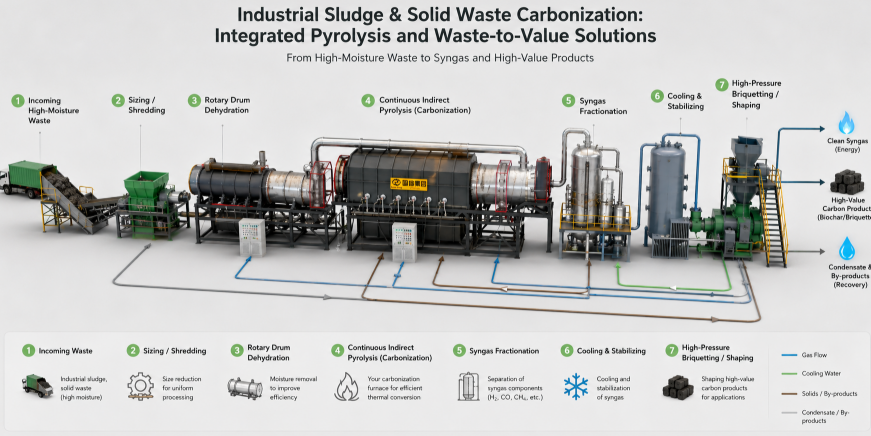
[Incoming High-Moisture Waste] ➔ [Sizing/Shredding] ➔ [Rotary Drum Dehydration] ➔ [Continuous Indirect Pyrolysis] ➔
[Syngas Fractionation] ➔ [Cooling & Stabilizing] ➔ [High-Pressure Briquetting/Shaping]
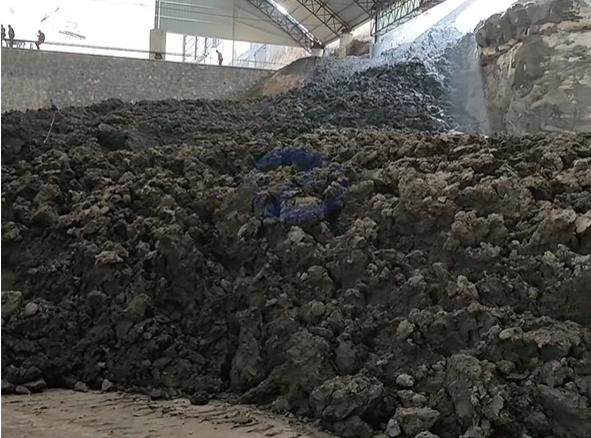
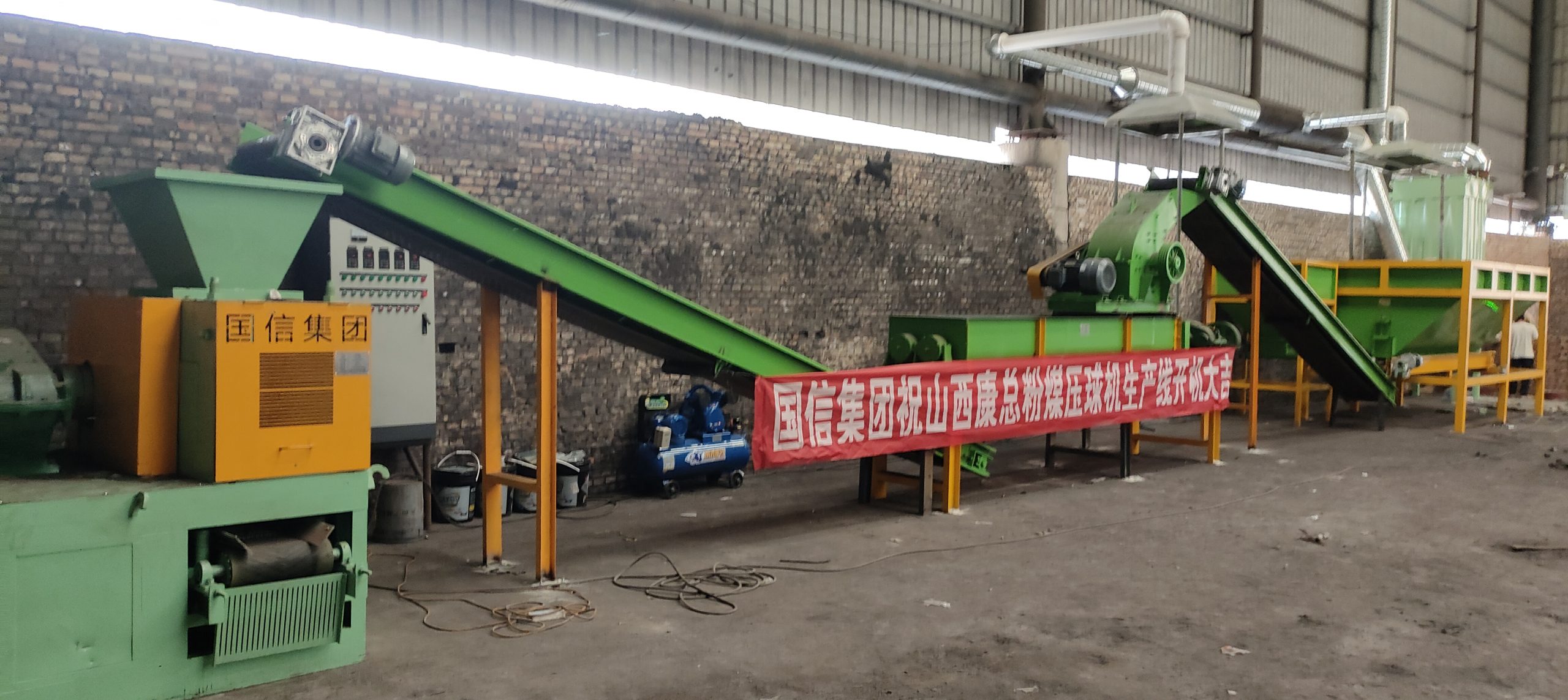
Sticky sludge cake or irregular solid waste fractions are routed through heavy-duty twin-shaft shredders or industrial granulators. This achieves a uniform particle sizing of ≤ 20mm, preventing blockages and ensuring uniform heat penetration during downstream thermal phases.
Because incoming sludges frequently carry moisture levels between 60% and 80%, the pre-drying phase is critical to system economics. Our multi-pass rotary drum dryers utilize high-temperature exhaust gas redirected from the carbonization kiln, bringing moisture levels down to ≤ 15% without consuming expensive external fuel.
The dried material enters the inner core of the Continuous Carbonization Furnace. Operating under a strict nitrogen-purged, oxygen-free environment, the material undergoes thermal decomposition. Precise PLC temperature modulation allows operators to tune the thermal profile to match the specific composition of the waste:
Volatized gases released from the waste are extracted under negative pressure into a multi-stage purification train consisting of cyclonic dust drop towers, tar scrubbers, and acid-gas neutralization units. The resulting clean, high-calorific syngas (CH4, CO, H2) is redirected directly into the kiln’s primary burners. This closed-loop thermal design cuts external fuel requirements by up to 65% during steady-state production.
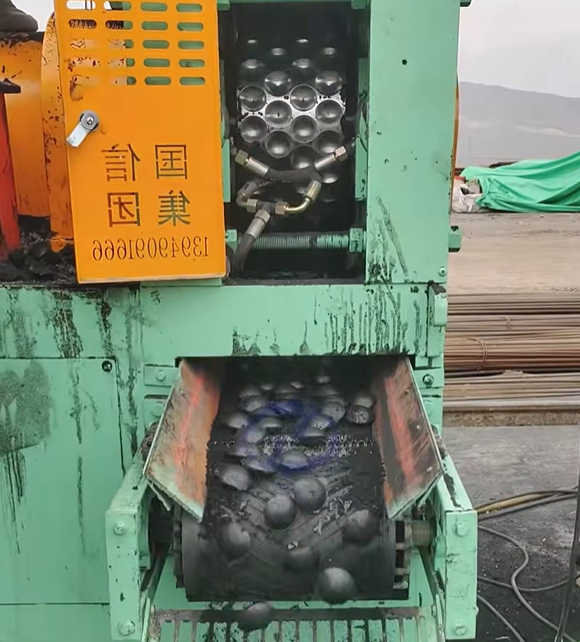
The hot, carbonized char is discharged via an enclosed, water-jacketed cooling screw conveyor, lowering the product temperature to < 50°C to prevent spontaneous oxidation. For clients targeting the solid fuel or construction market, the fine char is routed to an integrated high-pressure briquetting or mechanical shaping station, forming high-density blocks or pellets with excellent mechanical drop resistance.
| Engineering Parameter | Industrial Line Capability |
| Processing Throughput Scale | 10 Tons Per Day (TPD) to 150 Tons Per Day per single system train |
| Automation & Control | Centralized Siemens PLC with SCADA system and remote diagnostic integration |
| Kiln Structural Metallurgy | High-tensile, heat-resistant boiler plate steel (Q245R, Q345R, or 310S Stainless) |
| Heating Configuration | Multi-fuel burners compatible with Natural Gas, LPG, Diesel, and purified Syngas |
| Environmental Safeguards | SNCR De-NOx systems, lime-spray dryers, activated carbon injection, pulse baghouses |
| Emissions Standard Compliance | Fully compliant with strict international air quality standards (Particulates < 20 mg/m³) |
Q1: How does the system prevent the synthesis of highly toxic dioxins and furans during solid waste carbonization?
A: Dioxin synthesis typically occurs when volatile organic gases cool slowly in oxygen-rich zones containing chlorine between 250°C and 400°C. Our system avoids this through two design principles: first, the pyrolysis chamber operates in a strictly oxygen-free environment, suppressing oxidation; second, the extracted syngas is incinerated at temperatures exceeding 850°C with a 2-second retention time, followed by a rapid-quench cooling phase, preventing de novo synthesis.
Q2: What is the maximum acceptable input moisture for industrial pulp or textile sludge?
A: Our integrated plant can accept raw filter-press sludge with moisture contents up to 80%. Highly saturated materials are passed through our multi-pass waste-heat rotary dryers first to bring the moisture down to the required ≤ 15% threshold before introduction to the pyrolyzer, protecting the thermal efficiency of the kiln.
Q3: Can the carbonized output from river dredging or municipal sewage sludge be sold commercially?
A: Yes. For municipal sludge with low initial heavy-metal content, the resulting bio-char is rich in phosphorus and potassium, making it an excellent soil conditioner or slow-release fertilizer base. For industrial or dredged river sludge carrying higher heavy-metal baselines, the immobilized char is highly suited as a zero-leach raw additive for cement kilns, brickworks, and asphalt manufacturing fillers.
Q4: How abrasive are non-metallic electronic waste fractions, and how does the machinery mitigate wear?
A: Non-metallic e-waste matrices contain high concentrations of abrasive fiberglass fibers and silica particulates. To counter accelerated mechanical wear, all internal lifting flights, mixing paddles, and discharge screws are fabricated from hardened, wear-resistant alloy tool steels or treated with specialized tungsten carbide hardfacing overlays, doubling the operational lifespan of the wear components.
