

Across the primary date-growing regions of the Middle East and North Africa (MENA), millions of tons of date palm branches (fronds) are generated annually during seasonal pruning. Due to their high fibrous structure and organic cell wall density, palm branches serve as an exceptional, low-cost feedstock for manufacturing high-margin hookah (shisha) charcoal.
Guoxin Machinery supplies complete, commercial-scale date palm branch-to-shisha-charcoal production plants.
Our continuous carbonization and hydraulic briquetting technology extracts volatile matter completely—delivering premium 25mm x 25mm x 25mm shisha charcoal cubes that meet strict Middle Eastern and European market standards: zero odor, zero sparks, crystal-white ash, and a 90 to 120-minute continuous burn time.
For agricultural project developers and investors in MENA, processing date palm waste transforms low-value biomass into a high-demand export energy commodity that directly competes with expensive coconut shell charcoal.
1.1 Technical & Chemical Transformation Data
| Quality Metric | Raw Date Palm Branches | Finished Premium Shisha Charcoal Cubes |
| Fixed Carbon (FC) | ~16% – 22% | > 82% (High heat retention) |
| Volatile Matter | 70% – 76% | < 12% (Odorless & smokeless threshold) |
| Ash Content & Color | ~3% – 5% | < 4% (Crystal-white / Silver ash) |
| Net Calorific Value | 3,900 – 4,300 kcal/kg | 7,100 – 7,500 kcal/kg |
| Bulk Density | 140 – 180 kg/m³ | > 1.3 g/cm³ (High-density post-pressing) |
| Burn Duration | N/A | 90 – 120 Minutes (No splitting on burner) |
1.2 Investment ROI & Sourcing Advantages
Abundant Low-Cost Feedstock: Raw palm fronds can be collected locally from palm plantations at minimal cost ($10–$20/ton handling fee).
High Market Value: Premium export-grade shisha charcoal cubes command $900–$1,400 per ton (FOB) depending on packaging and distribution channels.
Thermally Self-Sustaining: Our continuous carbonization furnace routes generated combustible syngas back to the burners, reducing external startup fuel consumption by up to 60%.
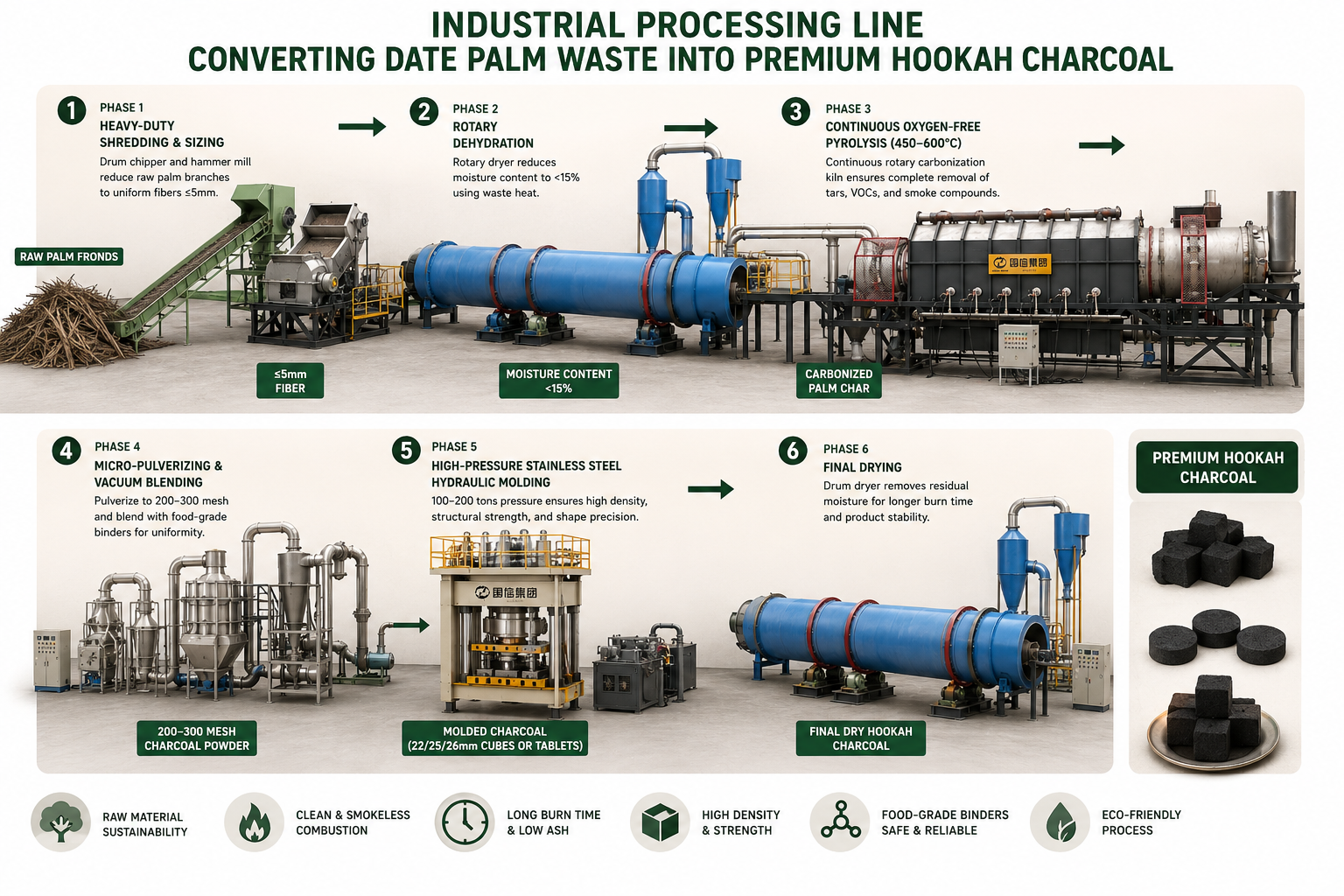
Manufacturing premium hookah charcoal requires a precise 7-stage industrial process to guarantee consistent cube density, smooth surface finishes, and zero-spark combustion.
[Raw Palm Fronds] ➔ [Shredding & Sizing] ➔ [Rotary Dryer] ➔ [Continuous Pyrolysis] ➔
[Hydraulic Shisha Press] ➔ [Drying Room/Dryer] ➔ [Finished Shisha Charcoal]
2.1 Heavy-Duty Shredding & Fiber Sizing
Raw palm branches are processed through a primary drum chipper and secondary heavy-duty hammer mill to reduce tough fibers to a uniform size of ≤ 5mm, ensuring smooth pneumatic feeding and uniform pyrolytic reaction rates.
2.2 Rotary Dehydration
Pruned palm fronds carry 25% to 40% moisture. High-capacity rotary dryers reduce moisture to < 15% using recycled thermal exhaust from the carbonization kiln, maximizing system energy efficiency.
2.3 Continuous Oxygen-Free Pyrolysis (450°C – 600°C)
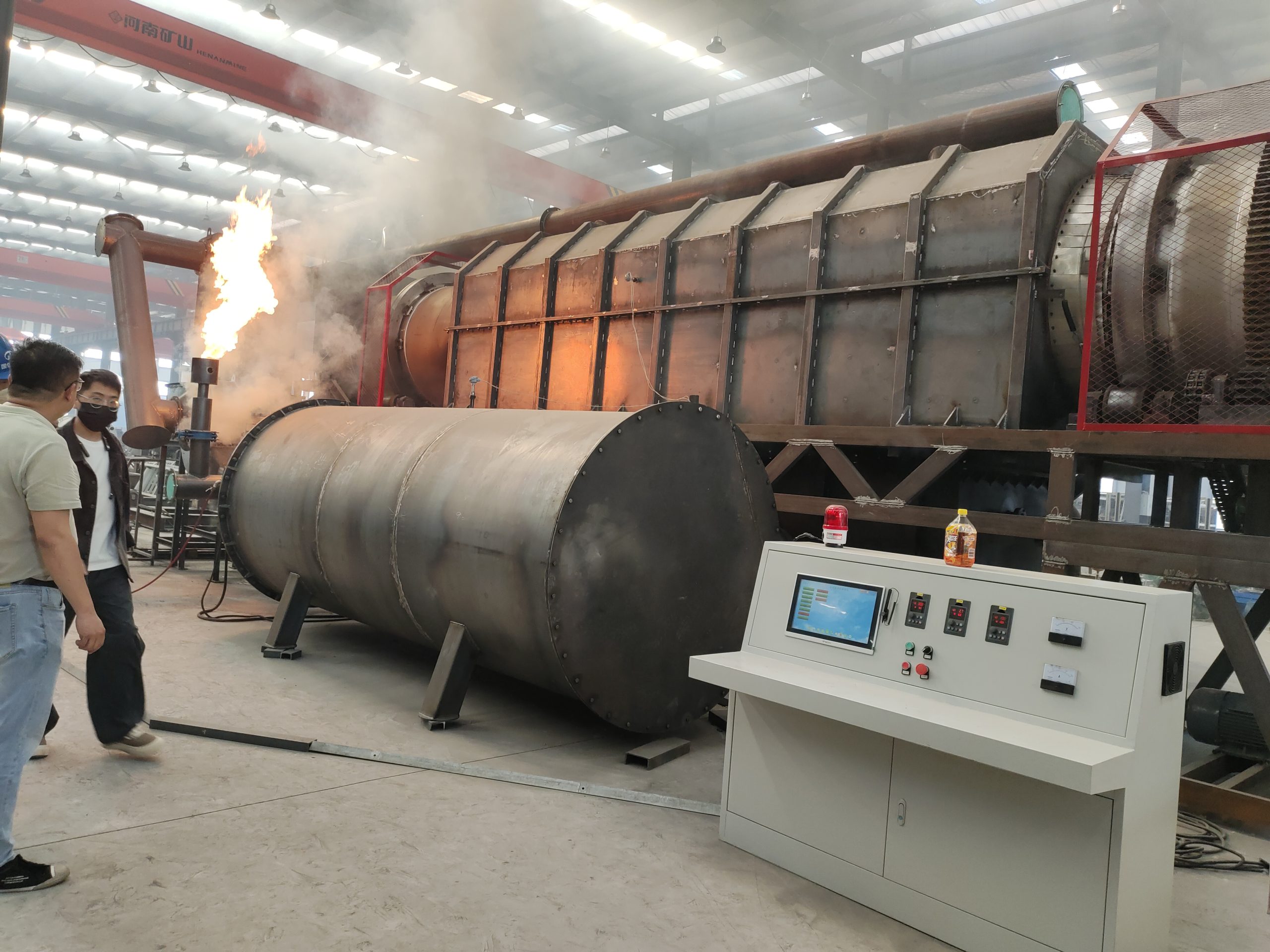
Conditioned palm material enters our Continuous Rotary Carbonization Kiln. Multi-zone temperature regulation expels wood tars and volatile organic compounds (VOCs), ensuring the final charcoal burns clean without smoke or chemical odors.
2.4 Sealed Anaerobic Water-Cooled Carbon Discharging
Hot charcoal exiting the kiln (450°C–500°C) passes through an enclosed water-jacketed cooling screw conveyor. This drops the charcoal powder temperature below 40°C in a fully oxygen-free environment, completely preventing spontaneous ignition.
2.5 200-Mesh Micro-Pulverizing
The cooled palm char is ground using a high-speed micro-pulverizer into an ultra-fine 200–300 mesh charcoal powder. Fine particle sizing is crucial to achieve smooth cube surfaces and prevent micro-cracks during pressing.
2.6 Binder Homogenization & Wheel Muller Mixing
Charcoal powder is transferred to a heavy-duty Wheel Mixer and kneaded with a 3%–5% natural, food-grade organic binder (tapioca or corn starch) and water. The wheel muller’s high compressive friction homogenizes the binder paste into a dense, moldable carbon mixture.
2.7 High-Pressure Hydraulic Shisha Cube Pressing & Drying
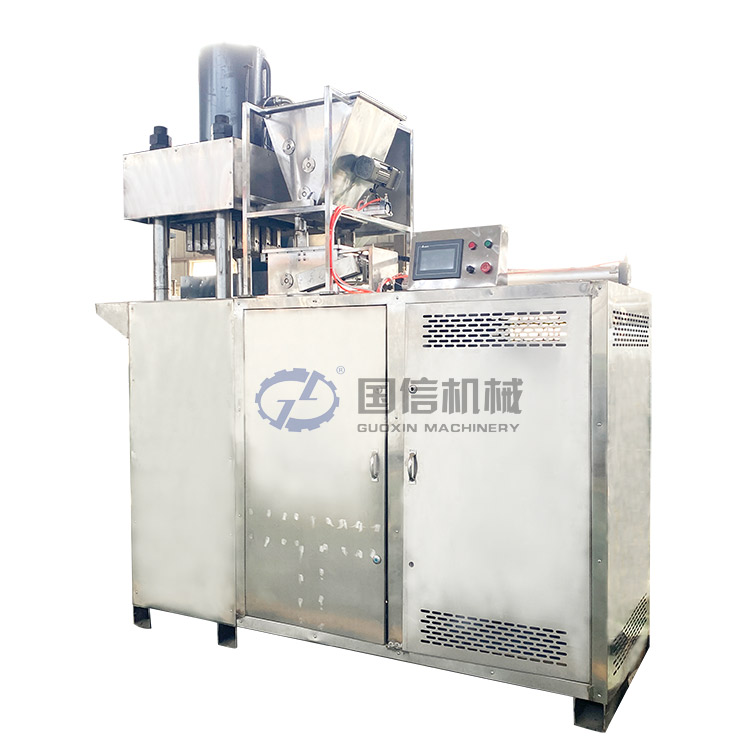
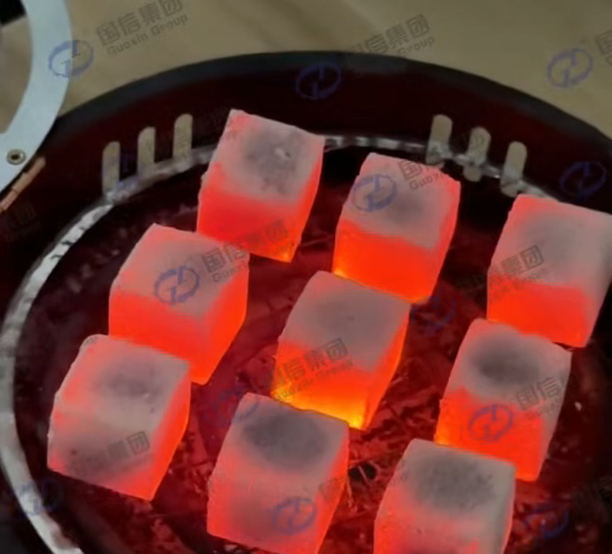
The carbon mixture is fed into a high-tonnage Hydraulic Shisha Charcoal Press applying 100 to 200 tons of continuous pressure. Quick-change stainless steel molds produce dense 22mm, 25mm, or 26mm cubes (or round tablets). Freshly pressed wet cubes then enter a temperature-controlled drying room or conveyor dryer to reduce moisture to < 5%, guaranteeing high structural strength and non-sparking performance.
| Subsystem Component | Industrial Engineering Capabilities |
| Finished Production Capacity | 1.0 TPH to 10.0 TPH (Tons Per Hour finished shisha charcoal) |
| Continuous Pyrolysis Kiln | Heat-resistant alloy steel (Q245R / 310S stainless) with VFD speed control |
| Char Cooling Discharger | Enclosed dual-layer water-jacketed screw conveyor (Discharge Temp < 40°C) |
| Micro-Pulverizer System | 200–300 Mesh ultra-fine powder classification with pulse dust collection |
| Hydraulic Press Force | 100 Ton – 200 Ton heavy-duty hydraulic station; stainless steel molds |
| Cube Dimensions | Standard 22x22x22mm, 25x25x25mm, 26x26x26mm cubes or custom tablets |
| Automation Platform | Centralized Siemens PLC touchscreen interface with remote SCADA telemetry |
| Emissions Control | Cyclone separators, tar scrubbers, and wet baghouses (< 20 mg/m³) |
Guoxin Machinery offers full Turnkey EPC (Engineering, Procurement, and Construction) project support for MENA developers:
Custom Factory CAD & Layouts: Tailored factory blueprints optimizing logistics between palm frond storage, carbonization zones, and clean packaging lines.
Chemical-Free Binder Formulations: Proven, food-grade starch binder recipes balanced specifically for date palm wood ash characteristics.
Global Installation & Commissioning: Senior engineers deployed on-site for foundation supervision, electrical integration, and local operator certification.
Q1: How does date palm branch charcoal compare to premium coconut shell charcoal for hookah use?
A: When carbonized continuously at 450°C–600°C and pressed under high hydraulic force, date palm charcoal achieves over 82% fixed carbon and low volatile content, matching coconut shell charcoal. It delivers a 90–120 minute burn time, high heat output, and the crystal-white ash preferred by shisha distributors.
Q2: Why is a wheel muller mixer required before the hydraulic shisha press?
A: Charcoal powder lacks natural cohesion. A standard mixer cannot knead binder paste uniformly into microscopic carbon pores. The heavy rollers of a Wheel Muller Mixer apply intense shear and pressure, transforming dry charcoal powder and starch binder into a uniform, dense paste required for solid, non-cracking shisha cubes.
Q3: How does the carbonization system handle the high mineral content of palm fibers?
A: Date palm fronds contain natural silica that increases machinery wear. Guoxin equips all high-friction components—such as shredder knives, mixer paddles, and hydraulic press molds—with hardened manganese alloys and 9Cr2Mo steel, extending service life by up to 40%.
Q4: How does the system guarantee zero smoke and zero odor during shisha combustion?
A: Smoke and odor stem from unburnt tars and organic volatiles. Our continuous rotary furnace operates with multi-zone temperature regulation (450°C–600°C) to fully drive off wood tars and VOCs. Cleaned syngas is piped to the furnace burners, ensuring the final charcoal is 100% pure carbon.
Henan Guoxin Machinery operates a material testing laboratory in Zhengzhou, China. Project developers and palm plantation owners can send raw date palm fronds for complete lab-scale carbonization, pulverizing, and hydraulic cube pressing trials.
Our engineering team provides:
Yield & Mass Balance Reports: Conversion ratios of raw fronds to finished shisha cubes.
Combustion & Ash Quality Tests: Precise bomb calorimeter testing, ash color verification, and burn duration analysis.
Custom Plant Layout Drawings: 2D/3D plant designs tailored to your factory dimensions.
