

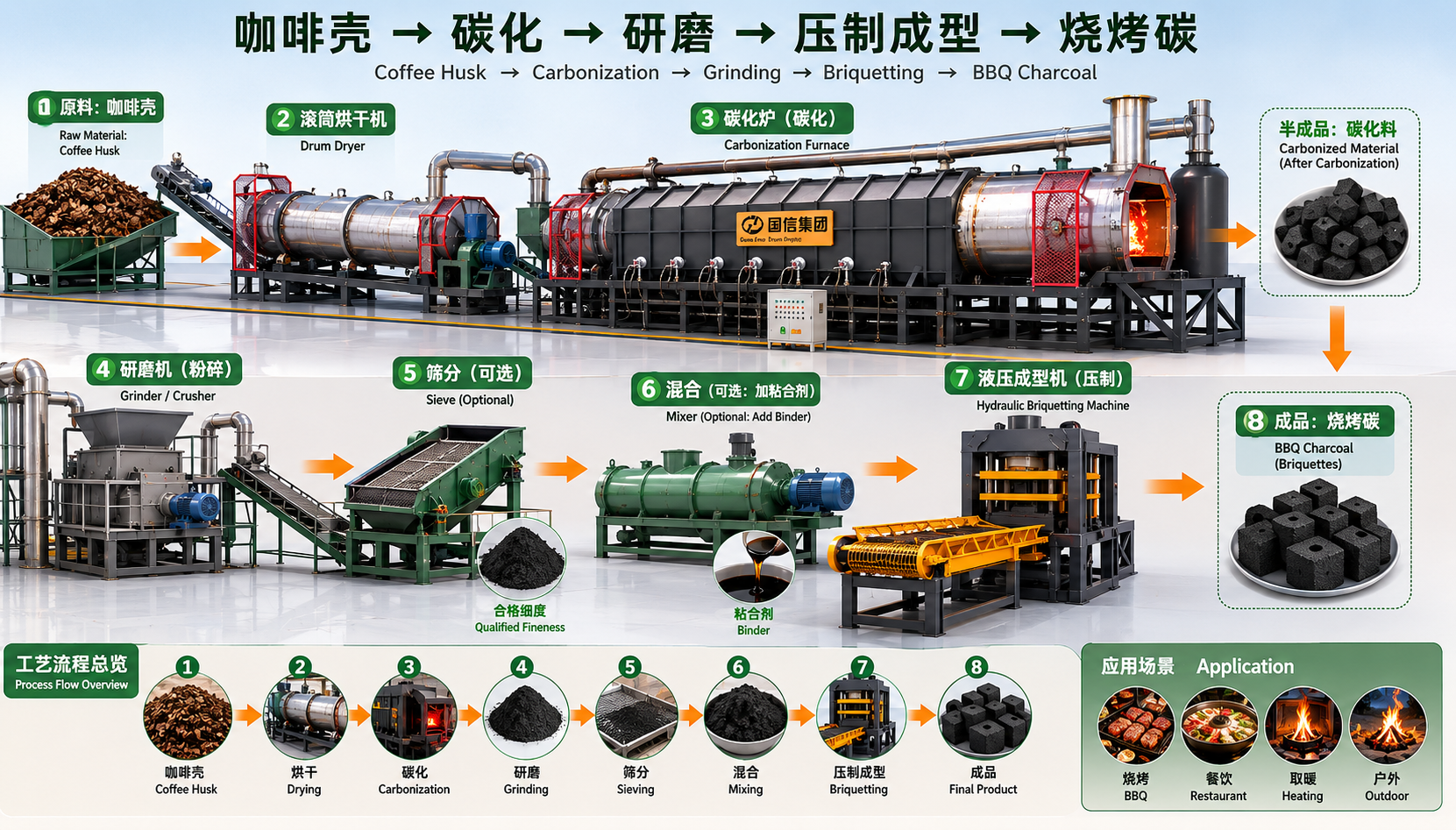
In major coffee-producing regions across Latin America, East Africa, and Southeast Asia, coffee husk (including coffee parchment and pulp residue) represents a massive, highly localized agricultural byproduct. While raw coffee husk is bulky and difficult to transport, its high lignin structure and residual natural compounds make it an exceptional feedstock for the premium barbecue market. When carbonized under strict thermal conditions, coffee husk charcoal retains a unique, subtle aromatic profile highly sought after by high-end culinary smokehouses and commercial grilling sectors.
Guoxin Machinery provides complete, industrial-scale continuous carbonization and briquetting lines that allow coffee processors and biomass investors to transform this seasonal waste into an exclusive, high-value energy commodity.
The commercial viability of coffee husk charcoal is driven by its differentiation from standard wood or lump charcoal. It transitions an agricultural waste liability into a specialized grilling fuel that commands a market premium.
Material Property Optimization Data
| Parameter | Raw Coffee Husk Residuals | Carbonized Coffee Charcoal Briquettes |
|---|---|---|
| Fixed Carbon (FC) | 16% – 20% | 78% – 85% |
| Calorific Value (LHV) | 3,800 – 4,200 kcal/kg | 6,800 – 7,400 kcal/kg |
| Volatile Matter | 72% – 78% | 12% – 15% (Preserves aroma precursors) |
| Ash Content | ~3% – 5% | < 6% |
| Sulfur Content | < 0.1% | Trace (Ensures clean, non-toxic burn) |
Commercial Advantages for B2B Investors
Premium Market Positioning: The natural aromatic characteristics of burning coffee husk charcoal allow exporters to target high-margin boutique BBQ markets in Europe, North America, and the Middle East.
Logistical Volume Reduction: Carbonization and briquetting condense loose, low-density husks into standardized, compact blocks, reducing warehouse footprint and international shipping costs per ton.
Self-Sustaining Processing: The integration of our syngas recycling system allows the production line to fuel its own thermal requirements, minimizing operational expenditures (OpEx).
Coffee husk has a lower bulk density and a faster thermal reaction time than solid hardwoods. Our continuous rotary systems are engineered specifically to prevent over-burning and optimize fixed carbon retention.
Phase 1: Regulated Pre-Drying
Depending on whether the sourcing mill utilizes wet or dry processing, coffee husk moisture can vary from 12% to over 35%. Our integrated rotary drum dryers utilize the waste heat from the carbonization kiln exhaust to stabilize the incoming moisture to a uniform < 15% before pyrolysis.
Phase 2: Continuous Oxygen-Free Pyrolysis (450°C – 600°C)
Dried husks are metered into the Continuous Rotary Drum Carbonization Furnace Precise PLC-controlled temperature zones ensure the material undergoes uniform thermal decomposition. This specific temperature window is critical: it concentrates the fixed carbon while preserving the specific organic structures responsible for the signature aroma, avoiding total destruction of the volatile flavor carriers.
Phase 3: Syngas Extraction & Thermal Closed-Loop
Volatilized gases released during carbonization are drawn into a multi-stage purification tower to remove heavy tars and wood vinegar. The clean, combustible syngas (CO, CH4, H2) is then redirected back to the kiln’s primary burners, reducing external fuel reliance by up to 65% during continuous operations.
Phase 4: Grinding, Blending, and High-Pressure Molding
The carbonized husk flakes are ground to a uniform mesh size, blended with natural, food-grade binders (such as organic tapioca or corn starch), and fed into a heavy-duty Hydraulic Press or Screw Extruder. This forms high-density hexagonal logs or pillow briquettes with excellent mechanical strength that do not crumble during transport.
| Parameter | Industrial Grade Line Capability |
|---|---|
| Hourly Output Capacity | 1.0 to 10.0 TPH (Tons Per Hour finished briquettes) |
| Core Kiln Metallurgy | High-grade heat-resistant boiler plate ( or customized alloy) |
| Molding Force Range | 100 to 250 Tons (Hydraulic systems for maximum durability) |
| Emission Standards | Fully enclosed design with integrated pulse dust collection (< 20 mg/m³) |
| Control Architecture | Centralized Siemens PLC with real-time HMI thermal monitoring |
Q1: Does coffee husk charcoal smell like coffee when burned?
A: It does not smell exactly like brewed coffee, but it produces a distinct, mild, wood-sweet aroma that is entirely different from standard hardwood or mineral coal. This unique smoke profile enhances the flavor of grilled meats, which is why it commands premium pricing in the commercial BBQ sector.
Q2: How does the system handle the lightweight nature of coffee husks?
A: Lightweight biomass is prone to turning into fly-ash if airflow is too aggressive. Our continuous rotary furnace utilizes a specialized internal sealing mechanism and low-velocity gas extraction loops to ensure the husks remain in the carbonization zone for the exact required residence time without being prematurely drawn into the exhaust system.
Q3: Can we process coffee parchment and coffee pulp along with the husk?
A: Coffee husk and parchment can be processed together seamlessly. If you are processing wet coffee pulp, it must go through our heavy-duty dewatering and pre-drying stages first, as its initial moisture content is too high for direct introduction into the pyrolysis kiln.
Q4: What is the typical lifespan of the molding dies and rollers?
A: Since coffee husk carbon powder contains minimal silica compared to rice husk, it is significantly less abrasive. Our hardened alloy steel molds and extruder screws typically process 3,000 to 5,000 tons of material before requiring standard maintenance or segment replacement.
