

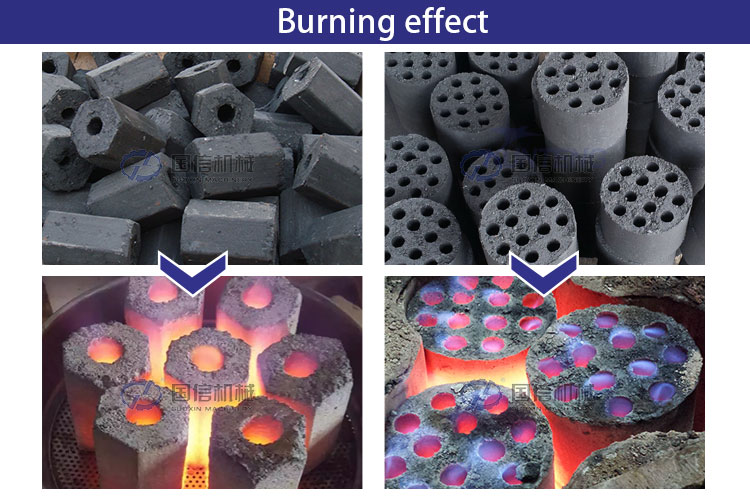
High-efficiency solid fuels have created a significant market for multi-hole honeycomb charcoal.
Designed for professional catering and industrial heating, this specific geometry utilizes a chimney effect to optimize oxygen intake, resulting in higher thermal output and zero carbon monoxide buildup.
Guoxin Machinery provides complete Turnkey EPC (Engineering, Procurement, and Construction) solutions to convert biomass waste into high-density bio-coal briquettes that outperform traditional lump charcoal in both burn duration and structural integrity.
Investing in a beehive charcoal facility is a strategic move for resource recovery in regions with abundant agricultural or wood waste. The commercial value lies in the engineered nature of the fuel, which commands a premium in the sector for Business-to-Business.
The Guoxin carbonization process significantly upgrades the chemical energy profile of the feedstock.
| Metric | Raw Biomass Residue | Carbonized Beehive Charcoal |
|---|---|---|
| Fixed Carbon Content | 15% – 20% | |
| Calorific Value (LHV) | 3,500 – 4,200 kcal/kg | 7,000 – 7,600 kcal/kg |
| Volatile Matter | 70% – 80% | (Smokeless Threshold) |
| Briquette Density | N/A |
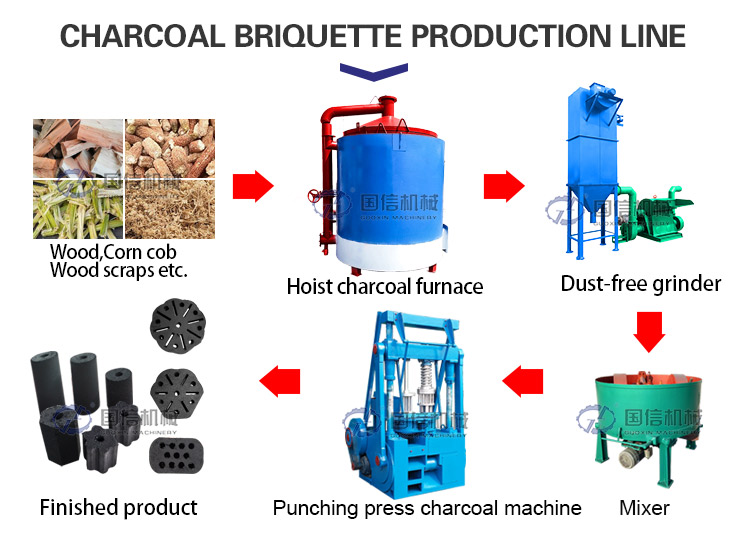
Our integrated line is designed for 24/7 continuous operation, focusing on energy linkage to reduce operational expenditure (OpEx).
Utilizing a Continuous Rotary Carbonization Kiln, the biomass is converted into high-purity charcoal. The system recovers combustible syngas, which is purified and redirected to provide thermal energy for the drying phase, reducing external fuel consumption by .
Carbonized material is ground to to ensure a smooth finish. Our double-shaft mixers utilize precision dosing (3%–5% ratio) of eco-friendly, organic binders to maintain structural strength without introducing chemical odors.
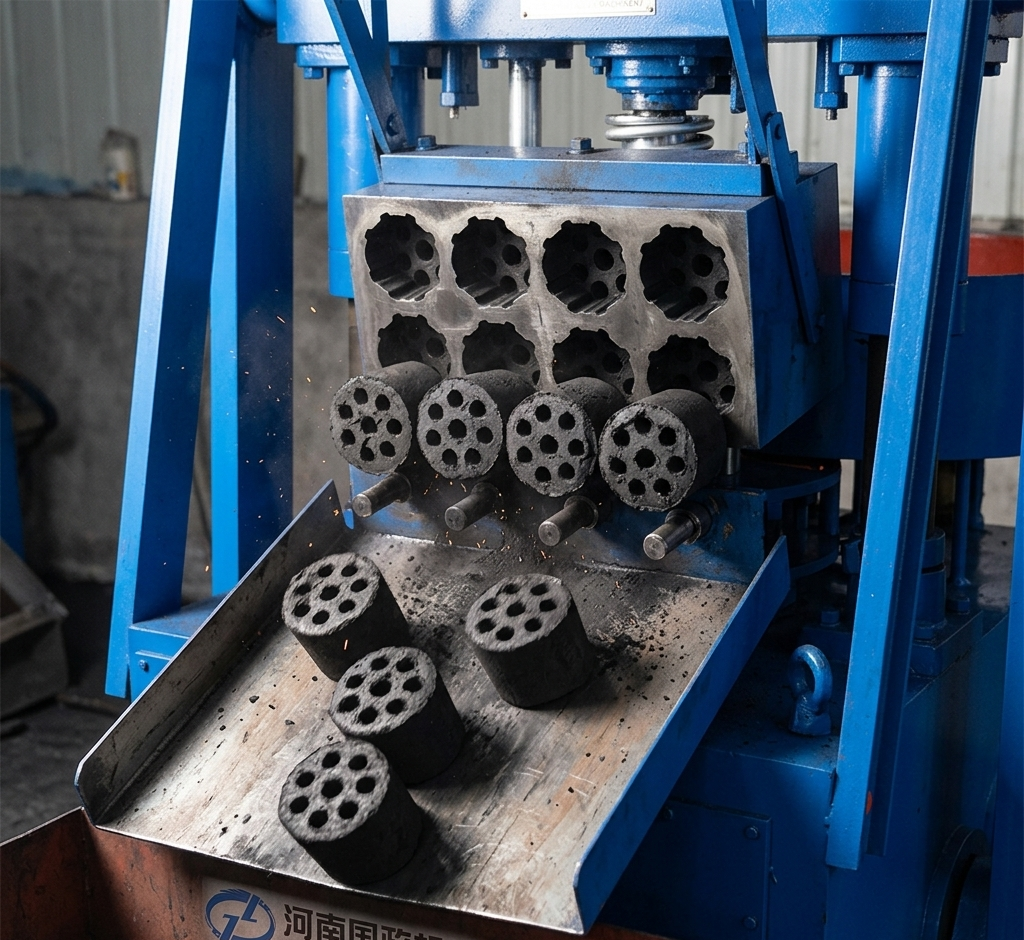
Unlike standard extrusion, our Mechanical Punching Press exerts massive downward force, creating the cylindrical multi-hole structure. Quick-change alloy molds allow for various beehive configurations (9, 12, 19, or 22 holes) to meet regional market preferences.
Moisture is reduced to in a multi-layer belt dryer or rotary drum dryer. This step is critical; uniform drying prevents internal thermal stress cracks, ensuring every perforated briquette gnites evenly.
| Parameter | Industrial Specification / Requirement |
|---|---|
| Installed Power | 150 kW – 450 kW (Scale-dependent) |
| Hourly Output | 1.0 – 10.0 TPH (Tons Per Hour) |
| Factory Area | 1,200 m² – 3,500 m² |
| Molding Pressure | Heavy-Duty Mechanical Beehive Punching Press |
| Emission Standard | Integrated pulse dust collectors () |
Request a Detailed ROI & Project Feasibility Study, Consult an Engineer: Customize Your Briquette Geometry
Q1: What makes multi-hole charcoal better than standard lump charcoal?
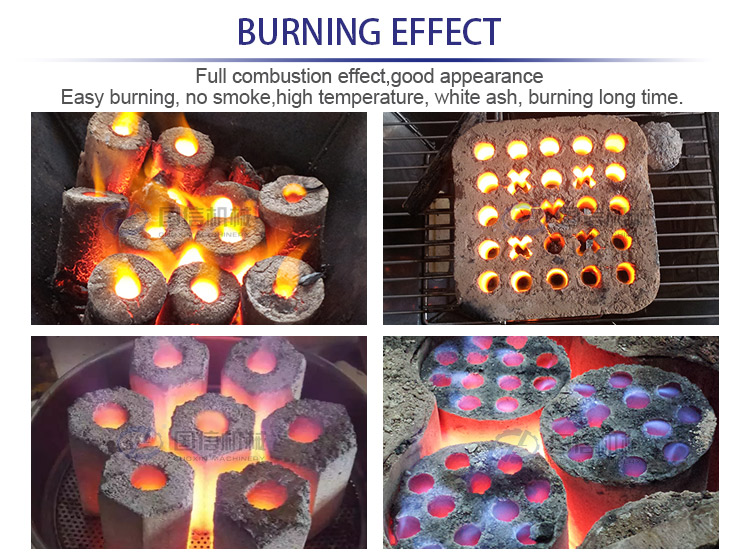
A: Standard lump charcoal has irregular airflow, leading to uneven burning. The honeycomb design ensures a constant oxygen supply through the vertical holes, providing a steady temperature and significantly longer burn times ( hours depending on height), which is essential for professional catering.
Q2: How do you prevent the briquettes from cracking during production?
A: Cracking is usually a result of poor mixing or improper drying. Our double-shaft mixers ensure the binder is perfectly distributed, and our multi-stage belt dryers use a gentle temperature gradient to remove moisture without stressing the carbon structure.
Q3: Can I use multiple types of biomass for the same line?
A: Yes. The system is designed for material flexibility. However, we recommend adjusting the grinding fineness and binder ratio depending on whether you are using softwood, hardwood, or coconut shells to maintain consistent density.
Q4: Is the syngas recycling safe?
A: Absolutely. Our gas purification system includes water seals, tar separators, and dust removers to ensure the recycled gas is clean and stable before it is reintroduced into the combustion chamber.
