

In integrated steel plants and merchant coking operations, the accumulation of coke breeze (coke fines) represents a significant operational challenge and financial loss. Due to its fine particle size (typically under 5mm), this high-carbon material cannot be directly charged into the blast furnace burden without severely restricting gas permeability and disrupting furnace aerodynamics.
Our heavy-duty, high-pressure roller briquetting lines convert unchargeable coke powder into high-density metallurgical briquettes. By recycling these fines directly back into the ironmaking process or cupola furnaces, steel mills can substantially reduce raw material procurement costs and eliminate environmental dusting liabilities.
The commercial justification for a coke breeze briquetting system is based entirely on operational expenditure optimization. It bridges the price gap between low-value byproduct fines and expensive metallurgical lump coke.
Material Property Recovery Technical Data
| Parameter | Raw Coke Breeze / Fines | Recovered Metallurgical Briquettes |
| Physical Sizing | 0 – 5mm (Irregular powder) | 30mm – 50mm (Pillow/Oval uniform shape) |
| Fixed Carbon (FC) | 84% – 88% | 82% – 86% (Accounting for binder matrix) |
| Cold Crushing Strength (CCS) | N/A | > 1,500 N / Briquette (> 150 kgf) |
| Drop Shatter Resistance | N/A | > 95% (2-meter drop test onto steel plate) |
| Moisture Content | Variable (8% – 15%) | < 3% (Post-dehydration zone) |
Direct Cost Substitution: Replaces a percentage of premium lump coke with processed briquettes in the blast furnace burden or ferroalloy electric arc furnaces.
Logistical Remediation: Eliminates environmental dusting fines and the associated handling penalties or landfill costs.
Thermal Self-Sufficiency Option: If paired with a coking gas system, existing plant waste-heat can be redirected to the briquette curing tunnel, minimizing external fuel usage.
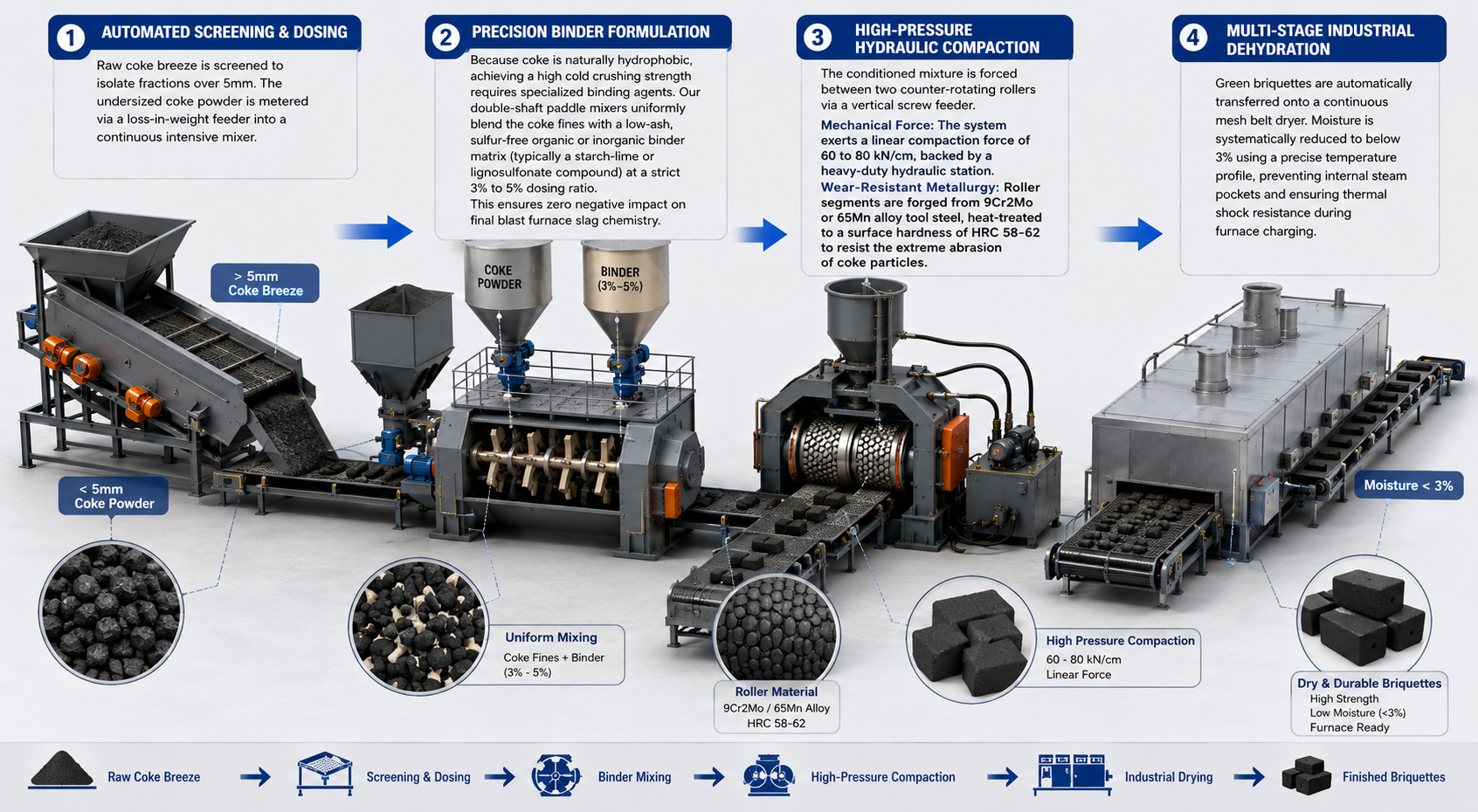
Coke powder is highly abrasive due to its inherent ash structure and mineral inclusions. Standard briquetting machinery experiences rapid structural degradation of the roller surface. Our production sequence is engineered with wear-resistant metallurgy to withstand continuous, high-capacity industrial operation.
1. Automated Screening & Dosing of Coke Powder
Raw coke breeze is screened to isolate fractions over 5mm. The undersized coke powder is metered via a loss-in-weight feeder into a continuous intensive mixer to ensure a steady volumetric feed.
2. Low-Ash Binder Formulation & Mixing
Because coke is naturally hydrophobic, achieving a high cold crushing strength requires specialized binding agents. Our double-shaft paddle mixers uniformly blend the coke fines with a low-ash, sulfur-free organic or inorganic binder matrix (typically a starch-lime or lignosulfonate compound) at a strict 3% to 5% dosing ratio. This ensures zero negative impact on final blast furnace slag chemistry.
3. High-Pressure Hydraulic Roller Compaction
The conditioned mixture is forced between two counter-rotating rollers via a vertical force-feeding screw.
Mechanical Force: The system exerts a linear compaction force of 60 to 80 kN/cm, backed by an accumulator-stabilized heavy hydraulic station.
Wear-Resistant Metallurgy: Roller segments are forged from 9Cr2Mo alloy tool steel, heat-treated to a surface hardness of HRC 58-62 to resist the extreme abrasion of coke particles.
4. Mesh Belt Drying & Moisture Reduction
Green briquettes are automatically transferred onto a continuous multi-layer mesh belt dryer. Moisture is systematically reduced to below 3% using a controlled temperature profile, preventing internal steam pockets and ensuring thermal shock resistance during furnace charging.
| Parameter | High-Capacity Line Specification |
| Throughput Capacity | 3.0 TPH – 30.0 TPH (Tons Per Hour per single press) |
| Total Compaction Pressure | 150 Tons – 500 Tons (Hydraulic proportional valve regulation) |
| Main Motor Drive | Frequency-controlled (VFD) heavy industrial gearbox |
| Dust Containment | Enclosed transfer points with pulse-jet bag filters (< 20 mg/m³) |
| Briquette Geometry | Customizable (Pillow, teardrop, oval, or hexagonal) |
Turnkey EPC Delivery: Guoxin handles complete engineering integration, including robust feeding hoppers with anti-bridging vibrators designed for sticky, wet coke breeze.
Component Customization: Roller pockets can be sized precisely to match the permeability requirements of your specific furnace profile.
Formulation Support: We provide metallurgical lab testing of your coke fines samples to determine the lowest-cost binder configuration that satisfies your minimum crushing strength criteria.
Q1: How do coke briquettes behave under thermal load in the upper zones of a blast furnace?
A: The performance depends strictly on the binder selection. Our high-pressure compaction, combined with specialized carbonizing binders, ensures that the briquettes maintain structural integrity up to 400°C–600°C within the furnace shaft. This prevents premature degradation into fines before reaching the combustion zone, preserving gas permeability.
Q2: What is the expected operational lifespan of the high-pressure roller segments?
A: Given the high abrasiveness of coke powder, standard steels wear out within weeks. Our dual-alloy forged segments (9Cr2Mo) provide an operational lifespan of 6,000 to 10,000 tons of processed material per set of liners before requiring refurbishment or replacement, depending on the ash composition of the feedstock.
Q3: Will the binders used in the briquetting process increase sulfur or phosphorus levels in the hot metal?
A: No. We utilize specialized organic starches or industrial lignosulfonates that are inherently low in sulfur (S) and phosphorus (P). During the initial engineering phase, we analyze your target slag chemistry to ensure the binding matrix complies with your internal steelmaking quality standards.
Q4: Can this machinery handle variations in moisture within the raw coke breeze stockpile?
A: The hydraulic roller press requires a stable incoming moisture content of 8% to 12% for optimal binding. If your open-air stockpile exceeds this due to rainfall, we integrate an upstream rotary drum or flash dryer to stabilize the feed material before it enters the dosing system.
Henan Guoxin Machinery maintains a dedicated material testing facility in Zhengzhou, Henan, China. Overseas project engineers and procurement managers can submit raw material samples (including various biomass charcoals, agricultural residuals, and mineral powders) for complete lab-scale trial runs.
Our engineering team provides objective testing reports detailing:
