

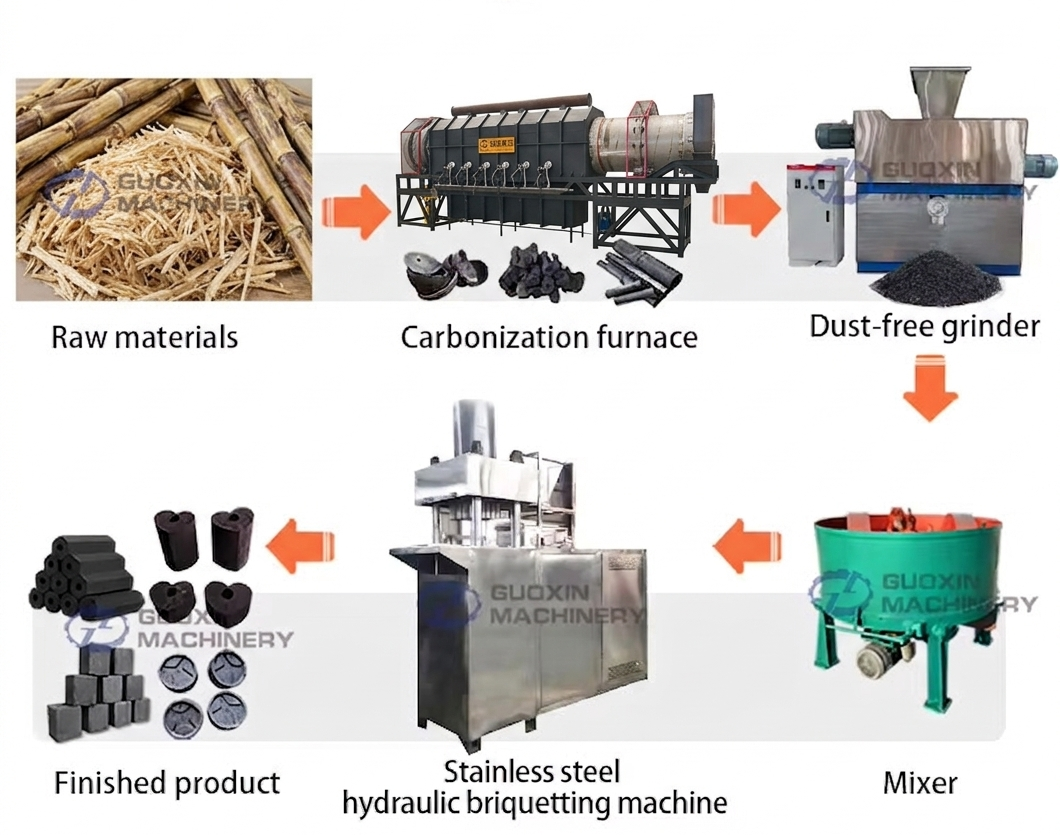
In the global sugar industry—particularly in Brazil, India, and Thailand—sugarcane bagasse is produced in massive volumes as a byproduct of crushing.
While raw bagasse is often used as a low-efficiency fuel for onsite cogeneration, its high moisture content and low energy density limit its transportability and commercial value.
Guoxin Machinery provides industrial-scale Continuous Bagasse Carbonization Plants that transform loose fiber waste into high-density Bio-Coal.
This process solves the logistical challenge of waste accumulation while creating a high-calorific, renewable fuel for industrial boilers and heavy industry.
For sugar mill operators, the primary challenge is the seasonal surplus of bagasse.
Carbonization significantly increases the energy density per cubic meter, turning a bulky waste product into a tradable energy commodity.
| Metric | Raw Sugarcane Bagasse | Carbonized Bagasse Bio-Coal |
|---|---|---|
| Moisture Content | ||
| Fixed Carbon (FC) | ~15% – 18% | |
| Calorific Value (LHV) | ||
| Transportability | Difficult (High Volume) | Efficient (High Density) |
The Guoxin bagasse line is engineered for the high-throughput demands of the sugar industry, featuring a specialized pre-drying stage to handle high-moisture mill discharge.
Given that mill-run bagasse typically exceeds moisture, our system begins with a High-Efficiency Rotary Dryer. This stage utilizes the waste heat from the carbonization kiln’s exhaust to bring moisture levels down to .
The dried bagasse enters the Continuous Rotary Carbonization Kiln. The fibrous structure is thermally decomposed in an oxygen-free environment, concentrating the fixed carbon and removing all organic volatiles.
Combustible gases (methane, CO, H2) are extracted, cleaned in a purification tower, and redirected to the furnace burners. This closed-loop energy recovery system is the key to maintaining the high ROI of the plant.
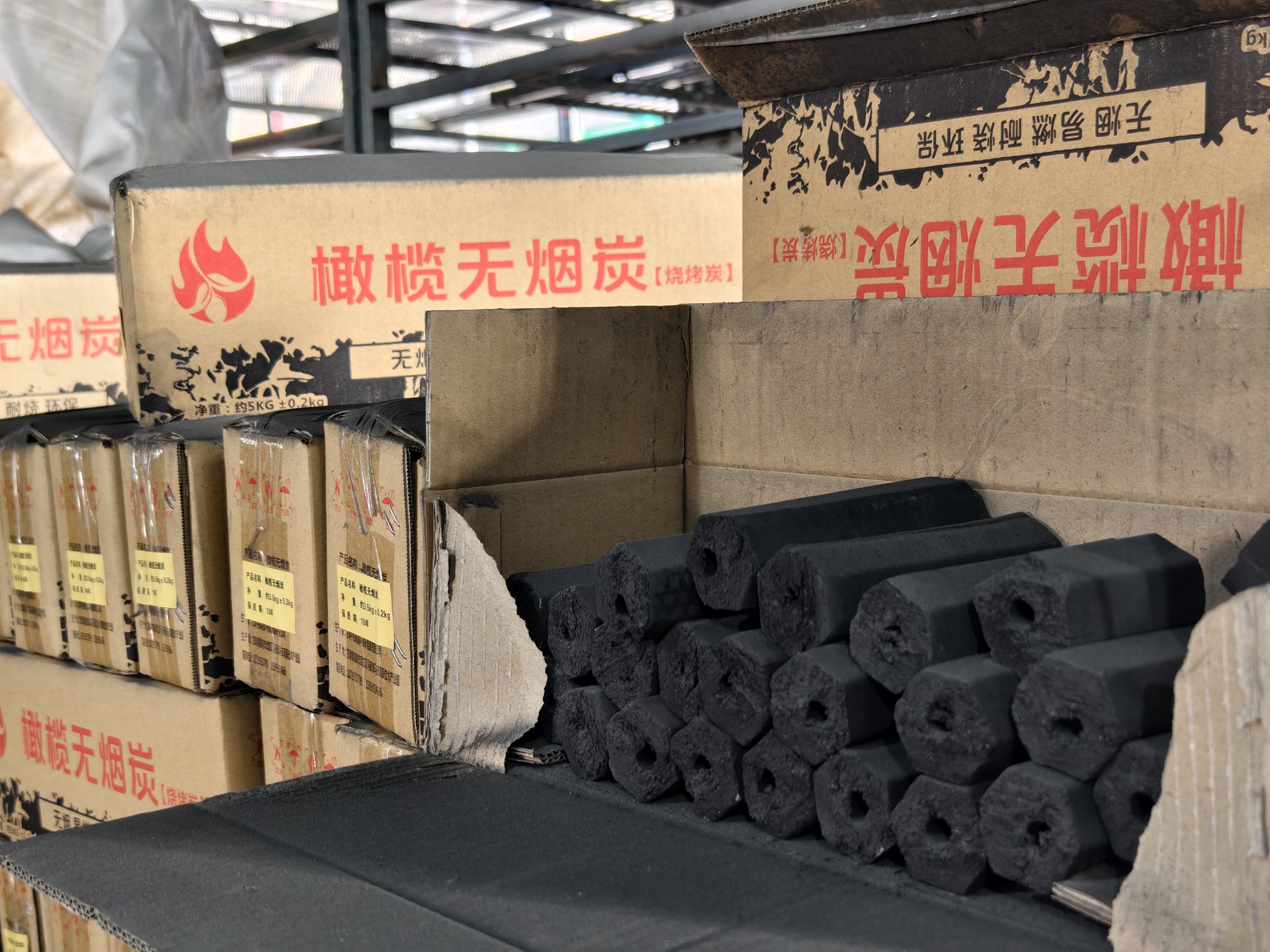
The carbonized powder is discharged via a water-cooled screw conveyor. For industrial boiler use, the charcoal is typically pressed into high-density Pellets or Briquette Logs to ensure consistent combustion rates.
| Parameter | Industrial Grade Specification |
|---|---|
| Feed Capacity | (Tons Per Hour) |
| Operational Scale | 24/7 Continuous (Matching Mill Crushing Season) |
| Core Components | High-temp boiler plate or Stainless Steel |
| Automation | Full PLC Control with HMI and remote diagnostic capability |
| Emission Control | Multi-stage Scrubber + Pulse Dust Collection |
Request a Professional ROI Analysis for Your Sugar Mill,Consult an Engineer: Design Your Bagasse-to-Fuel Production Line
Q1: Why is carbonization better than simply burning raw bagasse for steam?
A: Raw bagasse has a low Net Calorific Value because so much energy is wasted evaporating its internal moisture during combustion. Carbonization removes that moisture and the volatiles upfront, creating a fuel with the heat value that can be transported and sold outside the mill.
Q2: How does the system handle the low bulk density of bagasse?
A: Our rotary kilns feature optimized internal lifting flights that ensure the lightweight bagasse fibers remain in constant contact with the heat source without being carried away by the gas flow (fly-ash prevention).
Q3: Can the bio-coal be used in existing coal-fired boilers?
A: Yes. Bagasse bio-coal has combustion characteristics very similar to sub-bituminous coal but with significantly lower sulfur and ash content. It is an ideal drop-in replacement for industries looking to reduce their carbon footprint.
Q4: Is the syngas recovery system safe for continuous operation?
A: Absolutely. We implement multiple safety layers, including water-seal flame arrestors, pressure relief valves, and real-time gas composition monitoring to ensure the syngas recycling is stable and secure.
