

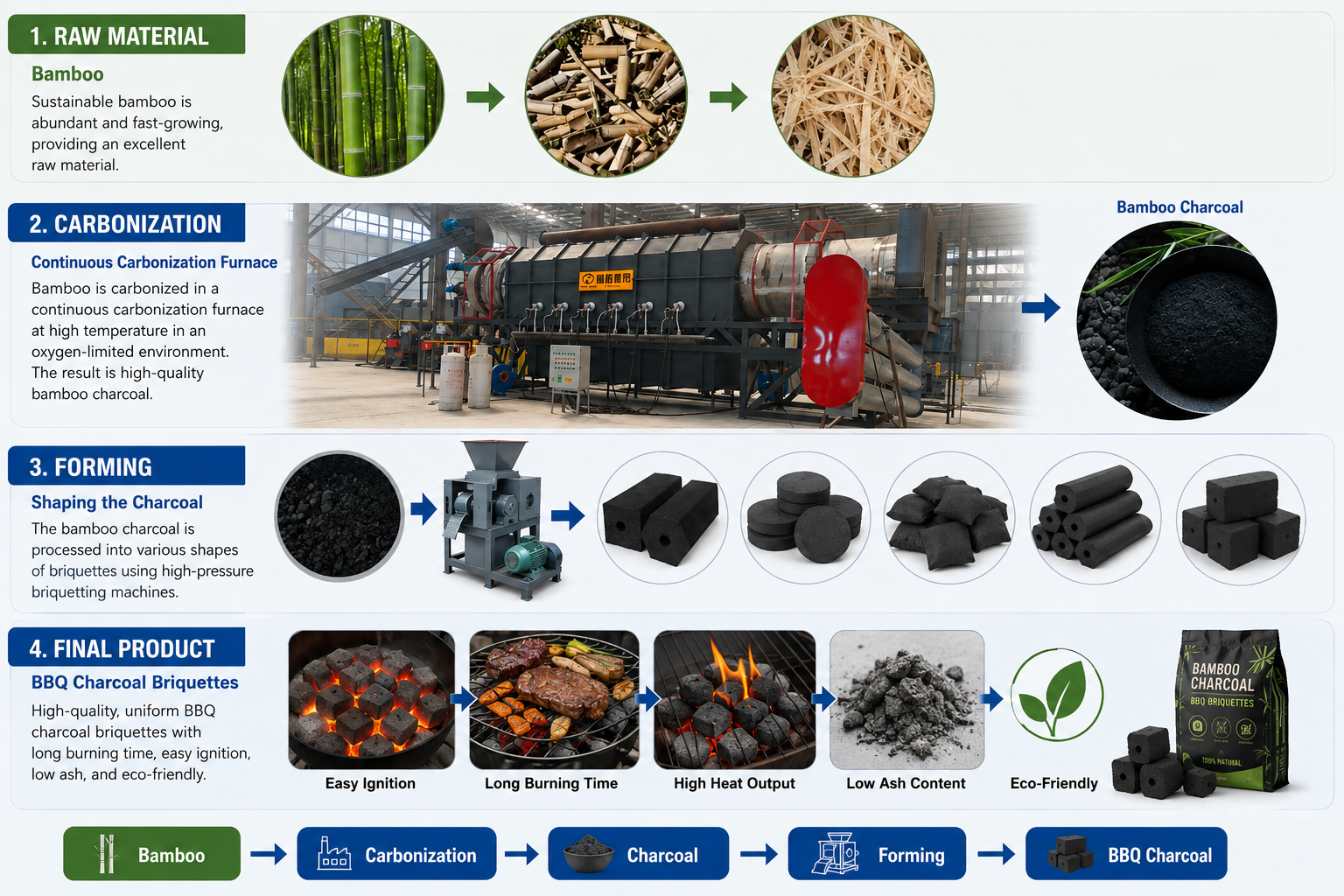
In the bamboo-rich regions of Southeast Asia and South America, the transition from raw bamboo to high-performance carbon is a high-growth industrial opportunity.
Unlike softwoods, bamboo possesses a unique vascular bundle structure that, when carbonized under precision thermal control, yields a charcoal with exceptional density and a vast internal surface area.
Guoxin provides integrated production lines designed to produce two high-value commodities: Premium BBQ/Catering Charcoal and High-Quality Activated Carbon Precursor.
For large-scale bamboo plantation owners and biomass investors, bamboo is the ideal green gold for carbon production due to its rapid renewal cycle and superior chemical properties.
| Metric | Raw Bamboo (Dried) | Bamboo Charcoal (Finished) |
|---|---|---|
| Fixed Carbon (FC) | 18% – 22% | |
| Specific Surface Area | Low | (Pre-activation) |
| Calorific Value (LHV) | 4,200 – 4,600 kcal/kg | |
| Density | (Pressed) |
Our lines are engineered to handle the specific fiber density of bamboo, ensuring uniform carbonization from the inner pith to the outer skin.
Utilizing a Continuous Rotary Carbonization Furnace, the bamboo (chips or segments) undergoes controlled thermal decomposition. By maintaining temperatures at the higher end of the spectrum, we maximize the Fixed Carbon content and begin the initial opening of the pore structure required for activated carbon precursors.
The bamboo carbonization process is highly exothermic. Our system captures the combustible volatiles (syngas), purifies them through a multi-stage scrubber, and redirects the gas to the furnace burners. This makes the plant thermally self-sufficient during steady-state operation, significantly lowering OpEx.
For the BBQ market, carbonized bamboo fines are processed through high-pressure Hydraulic or Screw Extrusion presses. This creates Bamboo Hexagon Logs known for their extreme hardness and metallic clink when struck—a hallmark of premium quality.
| Parameter | Industrial Grade Specification |
|---|---|
| Throughput Capacity | (Tons Per Hour) |
| Operating Mode | 24/7 Fully Automated PLC Control |
| Feedstock Flexibility | Bamboo poles, chips, sawdust, or factory off-cuts |
| Activation Readiness | Optimized for Physical (Steam) or Chemical Activation |
| Emission Standards | Integrated Pulse Dust Collection () |
Regional Expertise: Proven installation track record in bamboo-heavy markets like Vietnam, Thailand, and Colombia.
Material Science Focus: We don’t just sell machines; we provide the thermal profiles needed to achieve specific Iodine Values and Methylene Blue Adsorption targets for precursor production.
Rugged Construction: Our rotary drums are built with specialized heat-resistant alloys to withstand the high temperatures required for premium bamboo carbonization.
Inquire for Detailed ROI & Technical Specifications,Consult an Engineer: Developing Your Activated Carbon Precursor Grade
Q1: What is the difference between bamboo charcoal for BBQ and for activated carbon?
A: The primary difference is the carbonization temperature and residence time. BBQ charcoal is typically produced at to maintain some volatiles for easier ignition. Precursors for activated carbon are produced at to maximize fixed carbon and surface area. Our PLC systems allow you to switch between these profiles easily.
Q2: Can the line process Moso bamboo vs. smaller Bambusa species?
A: Yes. The rotary kiln design is agnostic to the bamboo species. However, for larger species, we integrate a heavy-duty crushing stage prior to carbonization to ensure a uniform particle size, which is critical for consistent quality.
Q3: Is a binder required for bamboo charcoal briquettes?
A: For the BBQ market, a organic binder (typically starch-based) is used to ensure the briquettes can withstand high-pressure molding and international transport without breaking.
Q4: How does the syngas recovery system handle the high moisture in fresh bamboo?
A: If the bamboo moisture exceeds , we install a pre-drying stage. This dryer uses the overflow heat from the carbonization furnace, ensuring that the moisture is removed without consuming extra fuel.
