

In industrial waste management, the recovery of slag and waste soil often poses significant logistical and environmental challenges. These materials are frequently loose, dusty, and difficult to transport or process. On the factory floor, we conducted a comprehensive test run using our High-Pressure Hydraulic Roller Briquette Machine to verify the mechanical transformation of these industrial residues into standardized, high-density briquettes.
The raw material for this test run consisted of industrial slag fines and waste soil with high mineral content. These materials often require a specific moisture balance and binder integration to achieve a “cold-press” bond that can withstand the physical loads of smelting or bulk transport.
The test run followed a precise engineering workflow to ensure material stability:
Material Preparation: The waste soil was pre-conditioned to reach the optimal pressing moisture range of 8%–12%.
Compression Logic: As observed in the test facility, the material is fed into the Hydraulic Roller Ball Press. The machine utilizes two counter-rotating rollers manufactured from 9Cr2Mo alloy steel to apply intense hydraulic pressure.
Forming Technology: The material is forced into precision-machined cavities, resulting in the “pillow-shaped” briquettes shown in the production output.
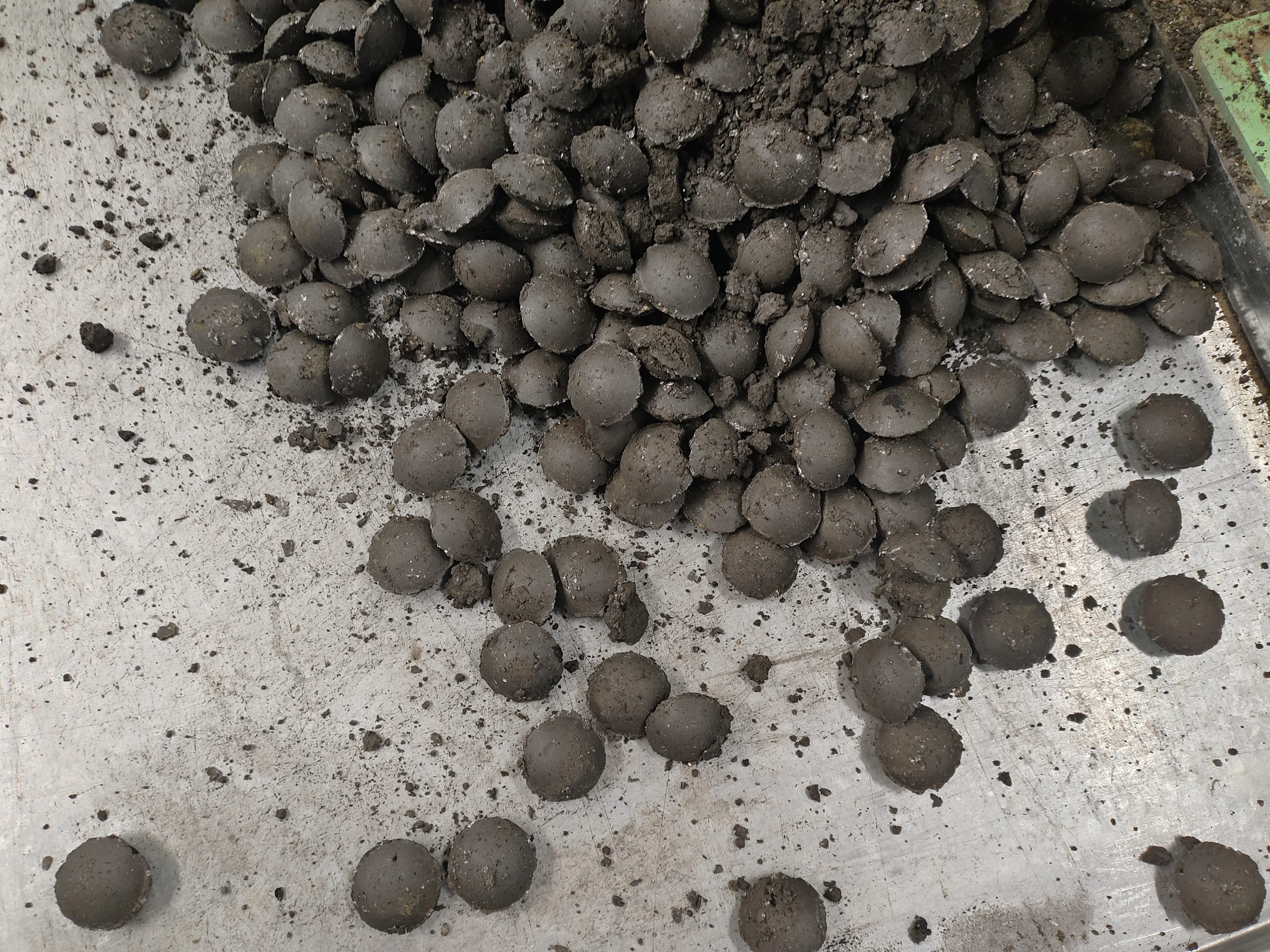
The test run achieved a high formation rate, with minimal fines recirculation:
Briquette Density: The resulting briquettes demonstrated high structural integrity, achieved through the cold-pressing method, which preserves the chemical composition of the slag.
Uniformity: Every discharge from the conveyor showed consistent sizing (approx. 40mm–50mm), essential for uniform airflow in smelting furnaces.
Surface Finish: The “clean-release” mold design ensured that the briquettes discharged smoothly without sticking to the roller surfaces.
For a full-scale industrial recovery plant, this briquette machine serves as the central forming station:
Upstream: A Wheel Mixer is recommended to ensure uniform binder distribution throughout the waste soil.
Downstream: To achieve maximum Cold Crushing Strength (CCS), fresh briquettes should be transitioned to a Mesh Belt Dryer for controlled dehydration before stacking or furnace charging.
Q1: What prevents the briquettes from breaking during transport?
A: The structural strength is a result of the hydraulic tonnage and the binder matrix. By calibrating the pressure to the specific gravity of the waste soil, we ensure the briquettes achieve the density required to survive high-stacking and mechanical handling.
Q2: How does the machine handle abrasive slag?
A: Industrial slag can be highly abrasive. We utilize specialized high-manganese or high-chromium alloy liners for the rollers. These liners are engineered for wear resistance and can be easily replaced, ensuring a low long-term operational cost (OpEx).
Q3: Is a binder always necessary for waste soil?
A: While some high-clay soils can be pressed “binderless” under extreme pressure, most industrial slags require a small percentage of binder (2%–5%) to ensure a high “drop strength” and resistance to environmental moisture.
Request a Technical Audit: Analyze the Pressing Feasibility of Your Slag or Waste Soil
